The Duty to Act: The Scientist’s Role in a Collapsing World
11 October 2025, 9:00-19:00
Humboldt-Universität zu Berlin
Dorotheenstraße 24, D-10117 Berlin
(!!! new venue !!!)
Live Stream via Webex
(can be viewed in the browser, please mind that the link only works WITHOUT the blankspace after .com/)
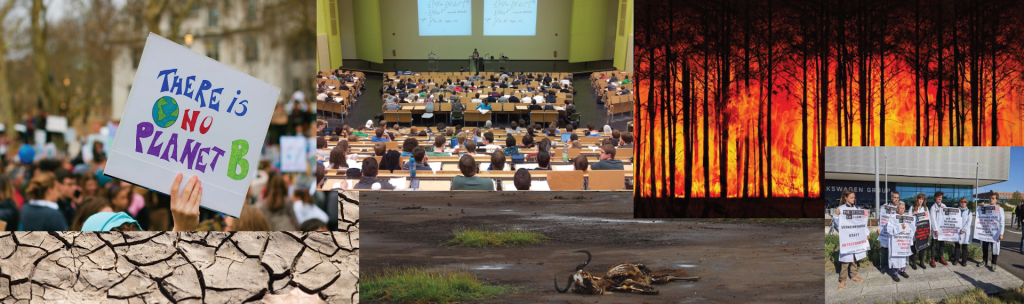
The Scientists Responsibility Summit invites a multidisciplinary, international audience of researchers to discuss the roles and responsibilities of scientists in the current social and geopolitical context. With the increasing threats to human civilization at large caused by the lack of political action on the climate and biodiversity crisis, a range of mechanisms have established themselves in the complex global context that make the position of academics uncomfortable and hard to grasp. Scientists know and research these mechanisms just as well as climate-related phenomena, but their research is basically ignored in terms of geopolitical or social implementation. We are on the path to one of the worst IPCC scenarios, with all its consequences in terms of conflicts, migration and threats to global health. The ecological costs of an unsustainable economic system, combined with the rise of authoritarian, fascist tendencies, has multiple destructive effects on human well-being, biodiversity and earth systems. The question “What can we do about that?” has become increasingly pressing.
By bringing together experts from a range of disciplines, we strive to engage in a discussion that builds on state-of-the-art knowledge in the social sciences, while opening a fruitful dialogue with academics from the natural sciences, especially those working in climate or global health related domains.
Four key areas will be explored that are building on each other, starting from a historical perspective and spanning a range of sociological, geopolitical, media-related topics up to prospective scenarios:
1.) Transformative change in a historical and sociological perspective: What can we learn from previous phases of social transformation spearheaded by academics for the current crisis? How can scientists tactically engage with knowledge about complex social systems and their role within it?
2.) Post-truth societies and the role of digital media in the rise of fascism: How can universities react to the combined threat to academic freedoms posed by platform capitalism and authoritarian dynamics of power?
3.) Psychological mechanisms in the polycrisis, from resignation to empowerment: How do the discourses about individual footprints, earth system justice and activism affect wider public attitudes? How does research on moral implications in environmental behavior also impact the moral implications of research and science communication?
4.) Potentials of the degrowth paradigm: What are the alternative scenarios to the current economic system and what are the possible transformative solutions? What are the crucial academic structures and research directions to underpin such transformative approaches?
In all four sessions, the goal is to identify and discuss the role of academics and academic institutions, in terms of research orientation and of outreach as well as action potential and interaction with the broader climate and social justice movement.
This is the preliminary program:
9:00 – 10:30 – Perspectives on transformative change
Ilona Otto (Universität Graz): Social tipping dynamics in a world constrained by conflicting interests.
Amanda Power (University of Oxford): How to write new histories for a warming world
11:00 – 12:30 – Challenges of post-truth societies
Ilyas Saliba (Hertie School of Governance Berlin): Attacks on Academic Freedom and University Autonomy and the responsibility of universities and scholars to defend against them.
Julia Bee (Ruhr-Universität Bochum) & Jasmin Degeling (Bauhaus Universität Weimar): Defending science, democratizing universities – media studies, political education, and anti-fascism
14:00 – 15:30 – From emotion to action
Michael Brüggemann (Universität Hamburg): How can disruptive climate protests be transformative? Inferences from media debates on Fridays for Future and Last Generation in Germany
16:00 – 18:00 – Potentials of degrowth
Max Koch (Lund University): Challenges for the Degrowth Transformation: The Role of Academia
Anke Schaffartzik (Central European University Vienna): Degrowth vs capitalism: A battle of the narratives?
Response by Matthias Schmelzer (Europa-Universität Flensburg)
Moderation: Maike Voss (neues handeln Berlin)

Time and Location:
11 October 2025, 9:00-19:00
Humboldt-Universität zu Berlin, Dorotheenstraße 24, D-10117 Berlin
Event in English spoken language
Please register for on-site attendance with the form on the sidebar (top right).
There is no registration fee.
The conference will be livestreamed, the link will be posted here.
Contact: m.grotkopp (at) fu-berlin.de + anne.baillot (at) dariah.eu
gefördert durch die Deutsche Forschungsgemeinschaft