I’m no expert on official punctuation rules, and there’s quite a bit of freedom in English anyway, but here’s one thing that will reduce mistake (and annoyance) rates drastically for some people: Germans, please don’t transfer German Kommaregeln to English! I know you’ve probably put a deal of effort into learning this in high school, but German punctuation rules, I regret to inform you, will lose rather than win you points in English. So please: DON’T PUT A COMMA IN FRONT OF EVERY THAT! That can be a relative pronoun (like which, which requires a comma if/because a non-defining relative clause ensues) or a conjunction, and in neither case does it need a comma!
Personally, I don’t think we should transfer English punctuation practices to German, either. I never put commas in front of the main verb (as in Anders gesagt, sind…)—after all, German’s a V2 language, and the position before the verb can be filled by complex constituents, so there’s no reason why I should. 🙂 But I think the Duden’s against me on this one. 🙁 In any case, you should have a good reason for putting a comma before the main verb in German. This is a general rule of thumb, actually: You should have a good reason for any comma you put.
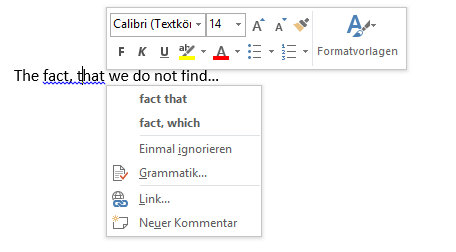
Here’s a case in point, from a recent paper I’ve received:
In English, unlike in German, not all relative clauses should have commas. A comma before a relative clause indicates that the relative clause is a non-defining relative clause, i.e. a relative clause that can be omitted because it gives extra information that is not essential to the clause. In the example above, the comma suggests that the conversational part of the BNC is the only corpus that was queried for the paper. But that is not, in fact, the case, which is why I was confused when I read the sentence. The paper in fact draws on several corpora. What the author wanted to say is that the BNC is the only one of the corpora used where the speakers were recorded at unawares. To convey this piece of information, the comma should have been left out.
I didn’t know there was such a significant difference between English and German punctuation. I found this very interesting, especially the explanation about the different uses of commas in relative clauses.
Personally, I mostly rely on gut feeling when placing commas in English. Other punctuation – like hyphens – are a lot more confusing to me, as they are almost never used in German; the same goes for semi-colons and colons, although that is more of a phenomenon of formal writing. The only comma rule I am really not certain of is the Oxford Comma, due to it being optional.
We went through every punctuation rule in 9th grade and then never unfortunately mentioned it again. Now I place commas based on what sounds and looks right to me, and remind myself every time that I shouldn’t place them based on German punctuation rules.
I do the same, I place commas intuitively. We need to develop different intuitions for each language by reading a lot of longer texts. I think my own intuitions about commas are definitely language specific; too many commas in English bother me because they disturb my reading flow. English uses the comma a lot less than German does — one more thing about language that is arbitrary but/and conventional.
My personal struggle with Enlgish punctuation is parentheticals. When I prepared for the IELTS, I learnt that they must always be demarcated by commas, but, after reading a certain number of academic articles, I feel that there are more undemarcated “thus” than those with commas. Also, as a Russian student, I heard that the speakers of this language tend to construct extra-long sentences that do not always meet the requirements for conciseness. It would be interesting to know if this notion is true in your practice.
This was actually really helpful! As a German speaker, I still catch myself putting commas in English the same way I would in German without even thinking about it. I never realized that putting a comma before a relative clause can actually change the meaning of a sentence in English. The example at the end explained it really well. I’ll definitely pay more attention to that from now on.