ISS is about to explore into the dynamics between Quaternary glaciations of northern middle Europe and subsurface Zechstein salt movements. Rooted in the field of Geomorphology, we use methods from Physical Geography (i.e. sedimentological analyses, terrain analysis) and combine them with geophysical methods or methods from structural geology.
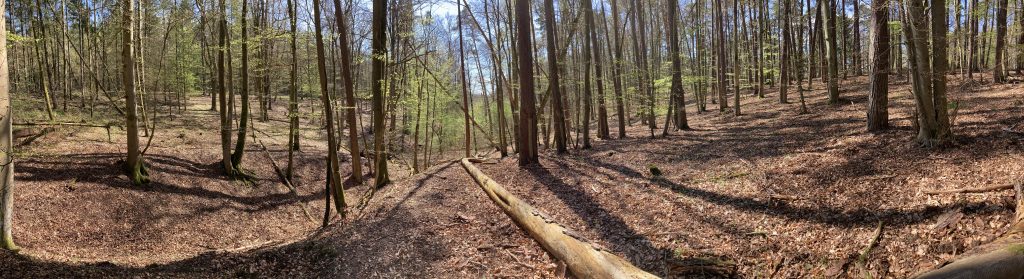
We have mapped and analysed more than 160 so-called surface cracks in northern Germany, landforms that cut through the Earth’s surface for up to several kilometers (Hardt et al., 2021). These cracks can be up to several tens of meters wide and we know that some of them are more than 10 m deep. Detailed investigations about their depth and infill, however, do not exist yet.
We realized that almost all of these cracks are located at the surface above Zechstein salt structures, i.e., salt pillows or salt domes, often even following the shape of the structures buried at depth. This led us to hypothesize that there might be some kind of connection. As the cracks cut through different generations of landforms of the young morainic landscape of northern Germany (i.e., outwash plains, till plains), it appeared probable to us that the Pleistocene ice sheets (in this case the Weichselian ones) are also involved in the process.
Already in the first half of the 20th century, researchers in northern Germany had speculated that ice sheets may have triggered salt movements. Our recent works provide evidence for this theory, which we were able to expand even further through analog modelling experiments (Hardt et al., 2024).
Within the framework of ISS, we continue to address detailed questions concerning, among other things, the more precise dating of the cracks. To this end, extensive fieldwork is being carried out at various locations to help us gain a better understanding of the relationship between landforms and salt tectonic movements.