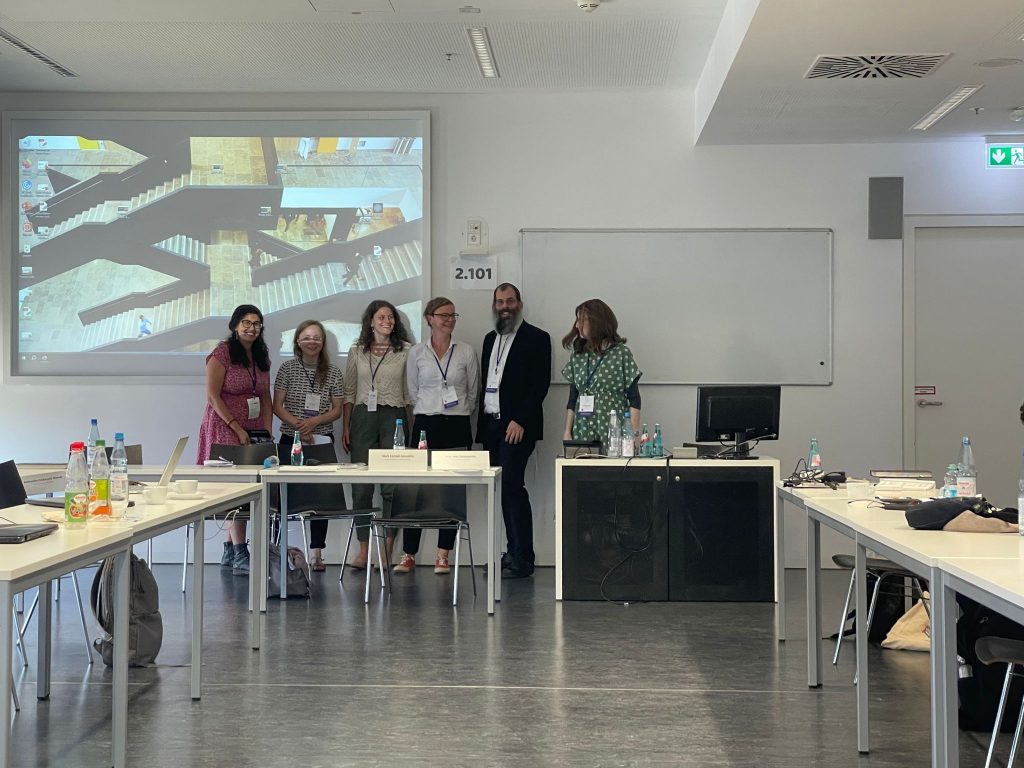
This July, our team had the chance to present our research project to the scholarly community during the 12th Congress of the European Association of Jewish Studies that took place at the Goethe University of Frankfurt am Main. Between July 16th and 20th, more than 700 Jewish Studies scholars from around the world came together to share and discuss new research findings.
Our panel, “New Perspectives on the Production and Interpretation of a Ritually Pure Torah Scroll” (Tuesday, 18th of July) attracted a diverse group of Jewish Studies researchers, scribes and material scientists. Chaired by researcher and scribe Mark Farnadi-Jerusálmi from the École Pratique des Hautes Études in Paris, our presentations raised many fascinating questions and discussions. We presented our research interests and methods as well as preliminary findings about scribal literature from the Middle Ages until the 19th century and exegetical interpretations of Tagin and Otiyyot Meshunnot. Participants learnt about our editorial work which is being enriched by tools developed within Digital Humanities.
Starting from the Middle Ages and then moving to the 19th century, Anne May Dallendörfer commenced the panel with a presentation on the editorial considerations that went into the various manuscripts and printed editions of Barukh SheAmar, a medieval scribal guide attributed to R. Samson ben Eliezer. Next, Annett Martini delved into the mystical, multi-dimensional interpretations of letters in Sefer Alpha Beta by R. Jom Tov Lipman. Dana Eichhorst then led the attendants of our panel on an investigative tour through the manuscripts of a text called Sefer Tagin that is commonly attributed to Eleazar of Worms and showed parallels between this Sefer Tagin and R. Eleazar’s other speculative writings. Lastly, Katharina Hadassah Wendl discussed pedagogical intentions in Keset HaSofer in light of new approaches to conveying knowledge and studying Jewish tradition in the 19th century. Participants were interested in hearing more about the interpretation of scribal traditions ranging from mystical elaborations on the meanings of the letter Aleph to the increasingly stringent application of scribal laws over time.
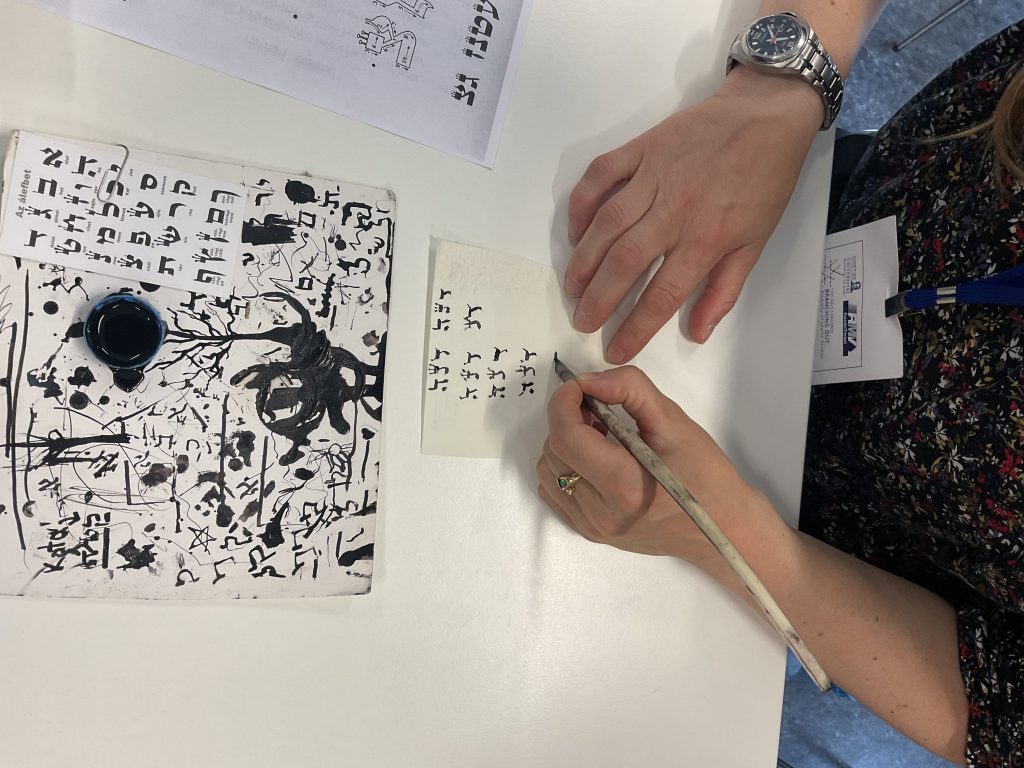
In addition to our panel on scribal literature, our colleague Zina Cohen also presented research findings about the composition of inks in medieval Torah scrolls. This research within the field of material science is also part of the interdisciplinary project “ToRoll: Materialized Holiness.” Anne May Dallendörfer and Katharina Hadassah Wendl also presented their research topics as part of the EAJS Emerge sessions for PhD candidates. Thomas Kollatz from the Academy of Sciences in Mainz, another project partner of “ToRoll: Materialized Holiness,” offered introductory and more advanced sessions on using digital research tools such as TEI and OxYgen as part of the Digital Jewish Studies Workshops. These took place in the early hours of the EAJS conference. During the sessions, Thomas Kollatz showed other researchers how our team uses Digital Humanities research tools. He was also so kind to answer our more specific queries on editing and analysing Jewish scribal literature via TEI and OxYgen. One evening, we also enjoyed participating in an impromptu workshop on how to be a scribe by our chair Mark Farnadi-Jerusálmi. Writing on klaf using feathers and ink, we made our more or less successful attempts at Safrut.
The 12th EAJS congress in Frankfurt am Main allowed us to meet former and new colleagues, discuss our research with others and learn about other projects within the field of Jewish Digital Humanities. During and in between panels, we also had fascinating conversations with researchers and scholars who we will be hosting in November for our online workshop on the Origin, History, & Interpretation of Tagin and Otiyyot Meshunnot for Writing the STaM. Looking forward to seeing you there!
Scribes can generally be considered artists and craftsmen. In contexts like the Jewish one, they are first and foremost preservers of holy texts and keepers of tradition. They are thus assigned a social role of great importance and their work is subject to strict rules with regards to form and ritual purity. At times, while preserving a fixed text and the tradition which depends on it, the scribe simultaneously gains access to a knowledge that is otherwise hidden from the other community members. He thus acts as a keeper of the community’s tradition at large but also as a guardian of a secret knowledge kept and preserved by only a few.
We find one such portrayal of the scribe in the 13th century Jewish scribal manual “Barukh she-amar” which has been attributed to the scribe R. Samson ben Eliezer.[1] In this manual, R. Samson sets out to rectify many of his fellow scribes’ mistakes and negligence concerning the writing of STaM (Sefer tora, Tefillin and Mezuzot). He thereby deals extensively with the manufacture of kosher parchment and the rules for writing. One aspect of these rules is the correct form of the Hebrew letters. It is here that the author discloses that he is in possession of some hidden knowledge, as he reveals the metaphysical meaning behind the letter shapes. Concerning this latter part, however, he seems hesitant to reveal too much as these are the secret aspects of his scribal knowledge. He even calls himself a “gossip” fearing he might disclose too much. Here is an excerpt from his writing:
And here I am, “A gossip goes about telling secrets” (Proverbs 11:13) with a little allusion for those who understand in accordance with my limited understanding. Although in my sins I am not worthy to allude to these great secrets which even hinting at [the fact] that I have a little knowledge [of them] is forbidden to me.
Perhaps the prohibition to share these “great secrets” hidden in the letter shapes is just a rhetorical device to give more weight and a sense of importance to his ensuing words. Nonetheless, throughout Rabbi Samson’s writing, one senses an underlying fear that this knowledge might fall into the wrong hands, much of which “was not given to be written.”
Though he finds himself unworthy to share these great secrets, he nonetheless does so, albeit in a quite enigmatic way:
For the dalet points out that the ‘ayin is kneset Israel and the oral Tora, the bride mentioned in Song of Songs, and she is Bakol the daughter of Abraham our father, and she is the kingdom of the house of David, and this dalet which is in eḥad is a thick one. And the vav which is on top of [the dalet] hints that the tav is the six ends [of the world] and a looking glass, it is the bundle of life, the tree of life, and the written Tora, and the two tagin which are on the vav hint at Bina and Ḥokhma the supreme, preceding and splendid, until Ein Sof.
Whatever these symbols hidden in the shape of the letters dalet and vav might mean, R. Samson ends with the comment:
And our rabbis, blessed be their memory, and the learned will understand. And the Lord, may He be blessed, revealed to me wonders from His Tora because of His great name.
It seems clear that Rabbi Samson believed that in his profession as a scribe he had witnessed “wonders” from the Tora through which he had received knowledge of the great secrets of God. In their form and shape, the Hebrew letters allude to symbols whose meaning is not self-explanatory at first sight. It is down to the scribe to learn, preserve and pass on this knowledge – to those who understand. Besides continuing the textual tradition, in learning the correct shape of the Hebrew letters the scribe acts as a preserver of a secret knowledge about God which is otherwise hidden from the uninitiated.
[1] It has been subject to debate whether R. Samson really was the author or whether certain excerpts can be attributed to others. The themes explored in the passage mentioned here have also been connected with his student Yom Tov Lipmann.
The authors of Sefer Hasidim turned with particular diligence to what is probably the most delicate subject of scribal literature, namely, the writing of the names of God in Torah scrolls. Paramount in the Hasidic context is the high quality of the writing materials, i.e., of the inks as they concern the names of God, and also the duty of the scribes to avoid disturbing in any way with their writing habits the notion of the absolute perfection of the name. God’s name must not exhibit any holes in its immediate surroundings or even be perforated itself. In the unfortunate case of a necessary correction, “approach not where the name is, so as not to pierce the name [with the needle], but there, where the parchment is unwritten.” A particular meticulousness in the script also affects to a certain degree the words before and after the names of God:
„A sofer who has written the name of God but without rendering it readable, should again go over it with the qulmus so that the letters of the word become readable. However, if he has already begun to write the name of God and not yet completed [it], he must not suspend [work on] the letters of the name in order to mend another word.“
(SH Ms Parma 3280 H, §715)
Yet it is not only the material, but also the flow of the writing act itself that does not tolerate absences or interruptions. The Sefer Hasidim takes up the image of the scribe known from ancient scribal literature, where a king is patiently waiting to be greeted by the sofer who is himself in this moment recording the name of the heavenly king on the scroll. In such a precarious moment, the scribe must not look up when one less than him enters the writing space and addresses him.
If he is not permitted to respond to the needs of others, how much more important is it then that the scribe also represses his own needs such as the urge to spit.
„When a sofer is writing the name of God, he may not spit as long as he is not finished, but only when he has written everything.“
(SH Ms Parma 3280 H, §719)
Ultimately, the Sefer Hasidim provides the scribe with solutions in the event that a name has been inadvertently misspelled.
One exceptionally interesting writing instruction, which clearly goes beyond the scope of the rabbinic guidelines, is found in the following paragraph:
„It is written [Ex 39,30]: [And they made the plate of the holy crown of pure gold,] and wrote upon it a writing, like to the engravings of a signet, HOLINESS TO THE LORD [יהוה]. [The employed plural] and they wrote teaches that the name should be written in the presence of a greater number of people meaning ten persons. Scripture says [Lev. 22,32]: [Neither shall ye profane my holy name;] but I will be hallowed among the children of Israel: [I am the LORD who hallows you.] Thus, the rishonim, when a Sefer Torah was written, wanted the names to be written by ten righteous. There are some who say: ‘It is necessary to write [the name of God] in the presence of a quorum as a reminder that it was written for the sake of [the divine name]. For if it was not written for the sake of [the name] [the scroll] should be stored in a genizah. This holds true for every single letter.“
(SH Ms Parma 3280 H, §1762)
This passage is remarkable because its author calls for bearing witness to the ritual sanctification of God’s name in the writing of a Sefer Torah. A group of ten “righteous people” should gather in the writing space for the transcription of each name, by which the tetragram JHWH alone is probably meant, to ensure the consecration of the name. The “ten righteous” awaken associations with the story of Sodom, which could have been saved by the presence of only ten righteous souls. It is said of the righteous (zaddiq), of whom there are but few in each generation, that they maintain an impeccable way of life and an intimate relationship with God. Their presence when God’s name is written not only guarantees the holiness of this moment, in which God represented by His name enters the world, but it also refers to the grace of God, who ensures through these righteous the continued existence of the world.
We do not know to what extent this procedure was actually put into practice. In the course of our project work, however, a growing number of medieval artifacts from the Ashkenazic region has been encountered that attest to a particular performative effort in writing the names of God. Thus, one finds not only special markings of the tetragram, but also names of God obviously added later to the Torah scrolls, standing out from the rest of the text by a different ink color or by letter size and shape.
Furthermore, studies of some surviving artifacts give reason to believe that the Hasidim also maintained their own tradition of placing tagin and otiyyot meshunnot as described in the relevant treatises on the subject within Hasidic circles. These „suspected cases“ will be further investigated in the coming months and – hopefully – be presented and described in a detailed publication soon.
Which will be the first one in the Torah (and how does this relate to a Torah scroll)?
Rebecca Ullrich
Anyone skimming through Midrash Bereshit Rabba comes across a very striking passage. In the name of Rabbi Yonah, quoting Rabbi Levi, a question is raised: Why was the world created with the letter „Beit,“ the second letter of the alphabet? Initially, it is stated that one should not explore what was before the creation of the world because the letter ב is closed off on its right side and open on its left; it is closed to the past, but open to the future.
This is followed by an interpretation by Rabbi Yehudah ben Pazzi in the name of Bar Kappara. He answers this question by explaining that the letter ב, with its numerical value 2, indicates that God created two worlds, this world and the world to come. After further interpretations in the name of various rabbis, the interpretation of Rabbi Elazar bar Chanina in the name of Rav Acha follows – and proves particularly interesting:
„For 26 generations, the letter Aleph protested before the throne of God and criticised the Lord of the world: „I am the first of the letters, and you did not create your world with me!“ The Holy One, blessed be He, said to the letter, „The world and its filling were created only because of the merit of Torah, for it says: (Prov 3:19) „Adonai set the earth with wisdom“. Tomorrow I will give the Torah at Sinai and will open the beginning only with you, for it is said: (Exo 20:2) „I (אנכי) am Adonai your God“. „
Genesis Rabba 1,10
God, who presents here a midrash of his own in the style of the rabbis, lets the letter Aleph wait until the next day when he will give Israel the Torah at Sinai, which will begin with an Aleph. According to God, he did not create the world because of a letter, but solely because of the merit of the Torah and to have his teachings obeyed.
This small passage is only one of several instances in rabbinic literature in which letters appear as actors. Genesis Rabbah 47:1, for instance, offers an interpretation in which the letter Yud, the smallest of all Hebrew letters, complains about having been removed from the name of Sarah (Sarah’s name was initially Sarai (Gen 17:15). God calms this letter down too, explaining that he had taken it from the end of a woman’s name and would now put it at the beginning of a man’s name: „And Moses called Hosea bin Nun Yehoshua“ (Num 13:16).
Around the 10th-11th century, more so-called „Smaller Midrashim“ appear that adopt the motif of personifying letters that give life to them. Apart from the beginning of the midrash „Asseret haDibrot“ („Midrash on the Ten Commandments“), the alphabet midrash, attributed to Rabbi Aqiva, is probably the best-known text in which letters appear personified: with voices, emotions and feelings. In this text, which has come down to us in various versions, the letters appear in reverse order before God, from the last to the first letter in the alphabet, one after the other. They ask Him to create the world with them, with interpretations of their forms and decorations.
Rabbinic literature includes several other short texts about more specific phenomena, such as letters to be written in larger or smaller font sizes, as well as letters that receive tagin („crowns“) or a certain dot. These special shapes and decorations are often found in Torah scrolls. Some of them also feature in Masoretic traditions. If so, they are discussed without justification as to why these letters have special features. Later scribal literature, such as Meiri’s Qeriyat Sefer, include lists of letters that need to be written in a larger font size.
The „Smaller Midrashim“ take this a step further and justify these phenomena, discussing, for example, the enlarged spelling of the letter „Beit“ (ב) of בראשית (Gen 1:1) in Torah scrolls. The reason given for the larger spelling of the letter is „that it precedes everything in the Scriptures.“ In the Shema Israel (Dt 6:4-9), too, there are two letters to be written larger in the first verse: The letter ע in שמע („hear“) and the letter ד in אחד („one“). The larger dalet in „Echad“ is needed, so the explanation, to prevent confusion between the letters “Dalet” (ד) and „Resh“ (ר), which look fairly similar, and mistakenly reading „another“ (אחר) instead of “one”. The enlarged letters are reminders for the correct pronunciation of the word at hand. Thus, in these rabbinic texts, letters become carriers of a message: They are assigned attributes in addition to their function of representing a sound. This way, they can also function as memory aids for motifs and events that should be remembered at this point in the text.
Forschende arbeiten zur Frage, wie Torarollen von der Antike bis zur Neuzeit hergestellt wurden und bis heute werden
Rabbiner Shaul Nekrich (r.) hält anlässlich des 76. Jahrestags der Befreiung des deutschen Vernichtungslagers Auschwitz am Internationalen Holocaust-Gedenktag die historische Sulzbacher Torarolle von 1792. Links: Rabbiner Elias Dray. Bildquelle: picture alliance/dpa/AFP POOL/Odd Andersen
Auf dem Papier abgebildet sind 188 Zeichen. Es ist etwa einen mal zwei Meter groß und hängt an der Wand hinter dem Schreibtisch – eigentlich ist es Tapetenrolle, in diesem Fall aber ein sehr großer Notizzettel. Die Zeichen sind in Wahrheit die 22 Buchstaben des hebräischen Alphabets und ihre zahlreichen Variationen. „Ich muss immer alles aufschreiben und visualisieren“, sagt Annett Martini. Auf die unterschiedlichen Schreibweisen der Buchstaben ist die promovierte Judaistin von der Freien Universität Berlin in Torarollen und Schreiberhandbüchern aus der Zeit vom 9. bis 15. Jahrhundert gestoßen. Die hebräischen Buchstaben sind verziert mit sogenannten Krönchen, also zusätzlichen Strichen, kleinen Bögen oder Fähnchen. „Die Krönchen stehen für eigene Narrative, die über den eigentlichen Text hinausgehen. Sie wurden nicht einfach gesetzt, weil es schöner aussieht“, erklärt Annett Martini. Dem Glauben nach habe Moses am Berg Sinai die Tora mit den Krönchen offenbart bekommen. Wofür genau die zusätzlichen Zeichen an den Buchstaben stehen, sei aber eine Frage der Auslegung. Mystiker zum Beispiel interpretierten einige der Krönchen aufgrund ihrer Form als Ohren, die bis in die Schöpfungszeit zurückhören könnten und dadurch zeigten, wie Gott die Welt geschaffen habe.
In den kommenden vier Jahren sollen die handschriftlichen Notizen auf Tapetenrolle digitalisiert werden und dann Forschenden und Interessierten online frei zugänglich sein; neben der digitalen Enzyklopädie soll auch eine virtuelle Torarolle erstellt werden. Das Vorhaben ist Teil eines neuen Forschungsprojekts mit dem Titel „ToRoll: Materialisierte Heiligkeit: Torarollen als kodikologisches, theologisches und soziologisches Phänomen der jüdischen Schriftkultur in der Diaspora“, bei dem es um jüdische Schrifttraditionen bei der Herstellung von Torarollen geht.
Eine Torarolle umfasst den Text der fünf Bücher Mose; sie gilt als das wichtigste Schriftwerk des Judentums, auch weil sie als Ritualgegenstand zentral ist für einen jüdischen Gottesdienst. Wieso sollte man sich dafür interessieren, wie eine solche Rolle hergestellt wurde? „Weil die Textanfertigung Teil des kulturellen Erbes des Judentums ist – und damit für Jüdinnen und Juden immens wichtig“, erklärt Annett Martini.
Auch eine virtuelle Torarolle soll neben der digitalen Enzyklopädie erstellt werden
Die Forschungsergebnisse könnten zudem etwas über das historische Verhältnis von Jüdinnen und Juden zu ihren nichtjüdischen Nachbarn aussagen. „Es gibt viele Vorschriften, die bei der Herstellung einer Torarolle einzuhalten sind. So müssen zum Beispiel Pergament und Tinte koscher sein. Das heißt unter anderem, dass beide Materialien möglichst von Angehörigen des Judentums nach alter Rezeptur hergestellt werden müssen“, erläutert Annett Martini. In Europa wurde das aber etwa vom 12. Jahrhundert an zur Herausforderung, als Jüdinnen und Juden in christlich geprägten Gesellschaften zunehmend aus Handwerksberufen verdrängt wurden. „Da wurde dann auch mal Tinte verwendet, die nicht aus jüdischer Herstellung kam. Oder man kaufte Beschreibstoffe wie Pergament aus christlicher Produktion.“ Das Studium von Quellen aus dieser Zeit lässt tief in das jüdisch-christliche Verhältnis blicken und kann dazu beitragen, überholte Sichtweisen von klaren konfessionellen Grenzen und Religionsgemeinschaften, die nur unter sich bleiben, zu hinterfragen.
Die Forschenden des Projekts untersuchen nicht nur die Schreiberliteratur aus der Antike und dem Mittelalter, sondern befassen sich auch mit neuzeitlichen Auffassungen zur Herstellung einer koscheren Torarolle. Hierbei stehen bestimmte Personen ganz besonders im Mittelpunkt: die Schreiber – „und seit einiger Zeit auch die Schreiberinnen“, sagt Annett Martini. In den letzten Jahrzehnten gibt es zunehmend auch Jüdinnen, die sich dem Schreiben einer Torarolle widmen; bis dahin war das ausschließlich Männern vorbehalten. Wie stehen jüdische Gemeinden zu dieser Entwicklung? „Das kommt darauf an. Orthodoxe Gemeinden erkennen Torarollen, die von Frauen geschrieben wurden, nicht als koscher an. Das heißt, sie würden sie nicht im Ritus verwenden. In liberalen Gemeinschaften ist die Akzeptanz deutlich höher“, erklärt Annett Martini.
Welche Stellung eine Schreiberin oder ein Schreiber innerhalb einer Gemeinde hat und was diese Personen auszeichnet, wollen Annett Martini und ihre Kolleginnen und Kollegen mithilfe von qualitativen Interviews herausfinden. Während einer Studienreise durch Israel hat Annett Martini bereits mit einigen Schreiberinnen und Schreibern gesprochen. „Geprägt durch die mittelalterlichen Quellen, hatte ich ein ziemlich romantisches Bild von einem Schreiber. Das wurde komplett auf den Kopf gestellt. Ein Schreiber berichtete mir, dass er erst in einem Jobcenter auf die Möglichkeit aufmerksam wurde, den Beruf des Sofer-STaM – eines professionellen Schreibers – neun Monate zu erlernen und dann in diesem Bereich zu arbeiten. Er war glücklich darüber, dass er nicht mehr trennen musste zwischen einem profanen Teil des Lebens, in dem eben auch für den Lebensunterhalt gesorgt werden müsse, und dem religiösen Leben“, erzählt Annett Martini. „Ein anderer Schreiber hingegen erzählte, dass er sich nur noch der Kalligraphie widmete, da er sich von den zahlreichen Schreibregeln, die es für eine Torarolle gibt, in seiner Kreativität eingeschränkt fühlte.“ Überraschend und beeindruckend seien für die Judaistin auch Unterhaltungen mit Schreiberinnen gewesen. Trotz der Kritik aus einigen orthodoxen Gemeinden und der Schwierigkeit, Lehrer zu finden, die auch Frauen in der Schreibkunst unterrichten, seien sie fest entschlossen, sich ganz dem Schreiben der heiligen Schriftrollen zu widmen.
„Die Textanfertigung ist Teil des kulturellen Erbes – und damit immens wichtig“
Annett Martini und ihre Kolleginnen und Kollegen haben bis 2026 – bis dahin läuft das Projekt – viel vor: „Uns interessiert die komplette Entstehungsgeschichte insbesondere mittelalterlicher Torarollen. Wann und unter welchen Bedingungen wurden sie geschrieben? Wie viele Personen waren an dem Prozess beteiligt? Welche Materialen kamen dabei zum Einsatz? Und was ist ihre Geschichte in den meist christlichen Bibliotheken?“ Die Judaistik, die sich vor allem mit der Geschichte und Literatur des Judentums befasst, würde jedoch irgendwann an ihre Fachgrenzen stoßen, wenn sie versuchte, diese Fragen im Alleingang zu beantworten. Darum sind neben den Instituten für Judaistik und Kunstgeschichte der Freien Universität Berlin auch die Bundesanstalt für Materialforschung und -prüfung (BAM) sowie das Karlsruher Institut für Technologie (KIT) an dem Forschungsprojekt beteiligt.
Geschichts- und kulturwissenschaftliche Fächer könnten von technischen und naturwissenschaftlichen Ansätzen profitieren, meint Annett Martini. „Mit computergestützten Methoden können wir sehr große Textmengen analysieren und miteinander verknüpfen. So können zum Beispiel in der geplanten virtuellen Torarolle nicht nur paläographische Traditionen vergleichend erfasst werden. Die digitale Edition von Texten aus unterschiedlichen Zeiten und Regionen ermöglicht uns darzustellen, wie sich der Wissensschatz zur Herstellung von Torarollen entwickelt hat und auf welchen Wegen er weitergegeben wurde.“ Informationen zum Hintergrund von jüdischen Religionsschriften – etwa wie die Buchstabenformen und -krönchen innerhalb der jüdischen Schriftauslegung aufgefasst und bearbeitet wurden – könnten visuell besser erfasst und zugänglich gemacht werden.
Finanziert wird das Projekt mit 2,4 Millionen Euro vom Bundesministerium für Bildung und Forschung im Rahmen einer Förderlinie, deren Ziel es ist, sogenannte Kleine Fächer wie die Judaistik zu stärken. Als Kleine Fächer gelten wissenschaftliche Disziplinen, die über nur wenige Professuren verfügen. „Für das Fach Judaistik ist das eine Riesenchance, sich für andere Fachrichtungen und die Öffentlichkeit gleichermaßen zu öffnen“, sagt Annett Martini. Dafür sind zwei weitere Einrichtungen in das Projekt eingebunden: die Mainzer Akademie der Wissenschaft und Literatur sowie die Staatsbibliothek zu Berlin – Preußischer Kulturbesitz. „Zusammen mit der Staatsbibliothek etwa wollen wir am Ende eine Ausstellung zeigen, in der es um heilige Schriften geht. Nicht nur aus dem Judentum, sondern auch aus dem Christentum und dem Islam sowie aus dem ostasiatischen Raum sollen religiöse Texte ausgestellt werden. Kurz: aus verschiedenen Religionen, Regionen und Epochen“, sagt Annett Martini. Vielleicht erhält dann der große Notizzettel mit den 188 Buchstabenvarianten in der Ausstellung einen Ehrenplatz.