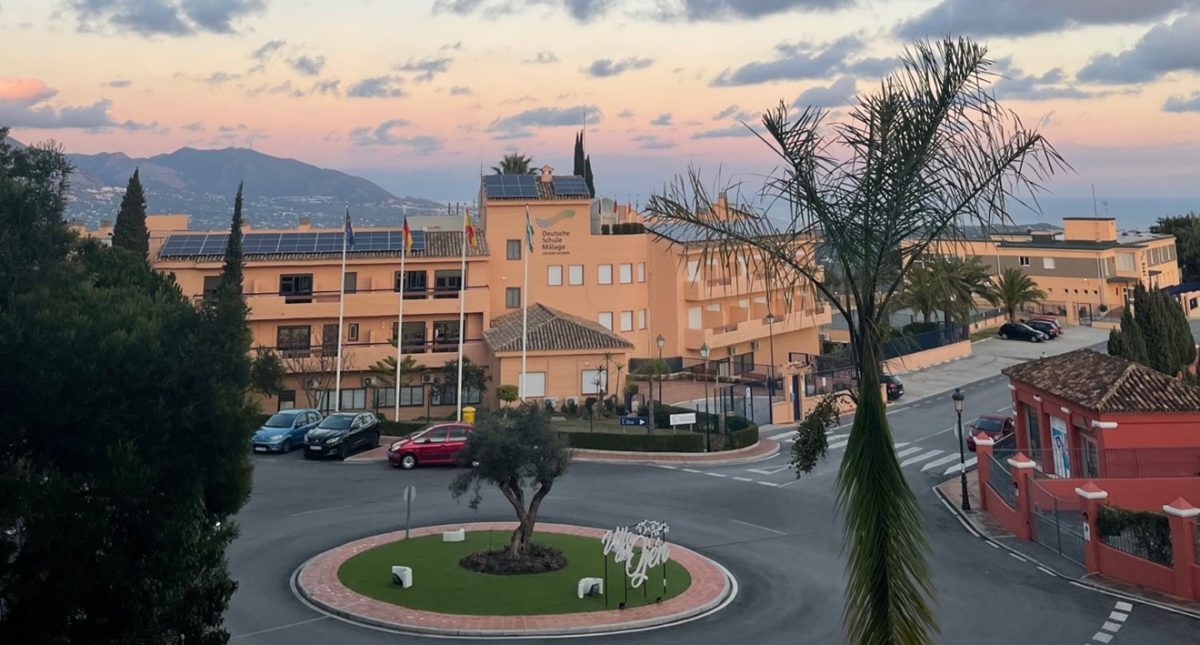
The German School in the province of Málaga, also known as Colegio Alemán de Málaga, is beautifully located approximately 15 km east of Marbella. Nestled on a hill surrounded by pine and cork trees, about 400 meters above sea level, the school lies in the residential area of La Mairena, in the district of Ojén, between Málaga and Marbella. Most students commute via nine official school bus routes, operating Monday to Friday.
As an independent private school, the German School Málaga holds a prestigious reputation. In 2008, it became the first school worldwide to receive the “Excellent German School Abroad” quality seal. Officially recognized by both German and Spanish authorities, the school is approved by the Spanish Ministry of Education and is operated under the supervision of the Standing Conference of the Ministers of Education and Cultural Affairs of the Länder in Germany. Additionally, the Central Agency for Schools Abroad (ZfA) supports the school in personnel and pedagogy on behalf of the German Federal Foreign Office. As a private institution, the school enforces strict guidelines, including a mandatory school uniform policy.For German-speaking students without prior knowledge of Spanish, the school offers a specialized Spanish as a Foreign Language (SaF) program. Students are taught in small, cross-grade groups for two years before being integrated into native-level Spanish classes. They continue receiving differentiated instruction for another two years before transitioning to regular Spanish lessons alongside native speakers.
Adapting Lessons to Students‘ Needs
The majority of the students at the German School Málaga were Spanish natives. This presented a unique challenge in subjects like biology, where we had to consistently adapt lessons to match their language proficiency. These adjustments required thoughtful lesson planning and a sensitivity to language acquisition barriers. This experience made me highly aware of the needs of Deutsch als Zweitsprache (DAZ) learners. I developed a deeper understanding of how to scaffold lessons effectively to support language learning while ensuring subject comprehension. This sensitivity toward DAZ students will undoubtedly inform my teaching practice moving forward.
Intern Accommodation: Comfort and Scenic Views
The intern accommodation was modern and well-equipped. Each room featured a single bed, desk, nightstand, and, depending on its location, either a stunning view of the sea or the mountains. The rooms also included a private marble-tiled bathroom with a spacious shower, which added a touch of luxury. The monthly rent was a reasonable €200.
Professional Growth Through a 16-Week Internship
My 16-week internship at the German School Málaga was one of the most enriching experiences of my teacher training program. Working at the school while sharing living space with twelve colleagues not only solidified my decision to pursue a teaching career but also helped me grow personally. I had numerous opportunities to observe experienced teachers, allowing me to expand and refine my knowledge. Additionally, teaching independently enabled me to develop my own teaching style and gain insight into essential teaching processes, such as lesson planning, execution, and reflection. These experiences undoubtedly improved my teaching abilities.
During the internship, I also created various teaching materials, which I can use in the future. Reflection on my teaching, along with preparation and improvement, became an integral part of my responsibilities. I am proud of the progress I made as a teacher and recognize that teaching is a lifelong journey of growth and learning. The opportunities provided during this internship have been invaluable.
Life in Costa del Sol
Spending my Praxissemester in the beautiful Andalusian region of Costa del Sol was an excellent choice. Escaping the cold German winter was a welcome change. I traveled to Málaga by car, which was essential for living in the intern apartment. In this shared space with twelve others, each of us had a private room with an ensuite bathroom, ensuring a good balance of privacy and communal living.
I worked approximately 20 hours a week, Monday to Friday, in addition to attending university-related seminars and tutoring four times a week. This made for a demanding schedule, but it was manageable and rewarding. My colleagues were incredibly supportive and welcoming, and my mentors provided invaluable guidance throughout my internship. I regularly taught classes, which enhanced my expertise and confidence as a teacher.
The school offers Spanish language courses for newcomers at the A1–A2 level, but beyond that, there were limited opportunities to improve my Spanish, as the environment was predominantly German-speaking. The Costa del Sol region is highly touristy, bustling with visitors in the spring, summer, and autumn. However, during the calm winter months, we often had the beaches almost to ourselves, making it a peaceful and enjoyable time.
Final Thoughts
In summary, my internship at the German School Málaga was an intense, challenging, yet highly rewarding experience. I gained invaluable insights, both professionally and personally, that far outweigh any minor drawbacks. I am proud of the progress I made and deeply value the opportunities this internship provided. I would highly recommend the German School Málaga to other prospective interns seeking a meaningful and enriching teaching experience.
Tips for other Interns
Preparation
Have an overview ready with all the submissions you need to hand in. Make a plan and start early. I don’t want to discourage you, but I consider this point crucial. This internship will be tough as you’ll have to work 20 hours at the school while simultaneously attending university seminars, handing in reports, giving presentations, etc.
Visa Application
As a European citizen, you don’t necessarily need a visa. However, there is a requirement for interns to obtain a NIE number, which can be challenging to request in Germany. It’s easier to apply for it at the local municipality in Spain.
Finding an Internship
Make sure to apply early! German schools abroad usually require applications at least 10 months in advance. Send your cover letter and CV as an unsolicited application to the school’s email address.
Finding Accommodation
I was lucky to have the opportunity to live in the intern apartment for only €200 per month. The apartment is shared with 12 other people. One thing is for sure—you’ll never be bored here. In general, renting your own place in Marbella or the Costa del Sol region is very expensive, as the area is known for its luxurious villas and tourism.
Insurance
I used the DAAD insurance, which cost only €38 per month. It was reasonably priced, in my opinion. I didn’t need to visit a doctor or hospital during my stay, so I can’t comment on the refund process.
Other Considerations
Having a car is absolutely essential. The school is located in a small village uphill. In La Mairena, there’s only a small kiosk where bread costs €6. However, the location is serene, with stunning ocean views. On clear days, you can even see Morocco. Another plus is the easy access to hiking trails starting right from the village.
Formalities On-Site
As mentioned earlier, you’ll need to have a NIE number and a criminal record certificate, as you’ll be working with children.
Phone/Internet
You can use EU roaming, which is very convenient. You can keep your German phone number. The apartment already had Wi-Fi set up.
Bank Account
You can pay almost everywhere by card. I didn’t need to open a Spanish bank account; my German bank account worked perfectly fine for the five months.
Other Considerations
Winter in Spain is absolutely mesmerizing, especially in the south. The weather is fantastic—I was able to go swimming in December and January. Escaping Berlin’s harsh winter was the best decision I could have made.
Everyday Life and Leisure
The area is full of beautiful beaches, mountains, and charming small villages. It’s perfect for weekend trips around the region. Málaga is just a 45-minute drive by car.
Nightlife
If you drive 20 minutes to Marbella, you’ll find plenty of beach clubs and bars. The nearest beach, Elviria, also offers restaurants and beach clubs. In La Mairena, there’s even a cocktail bar.