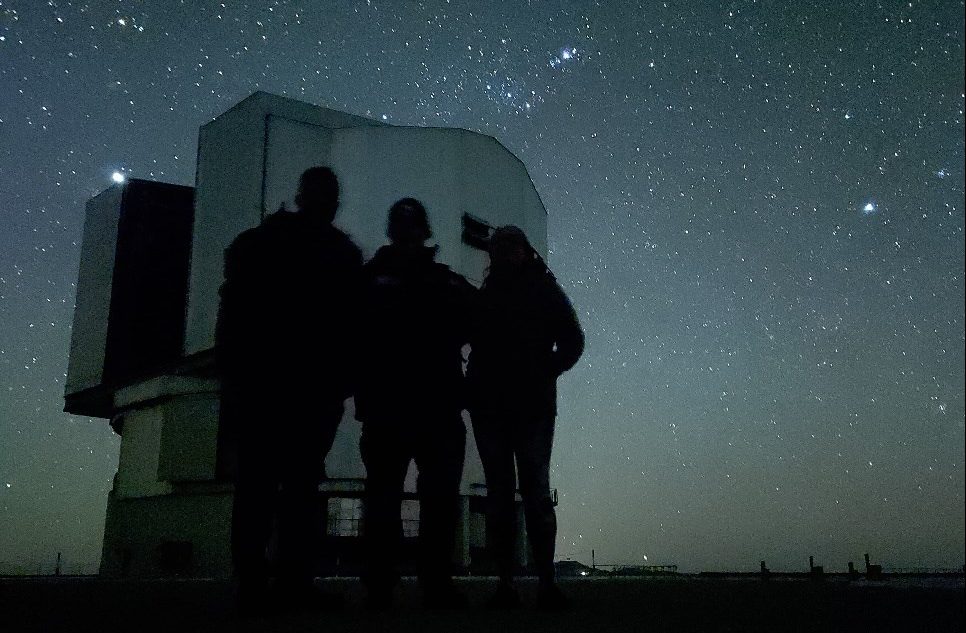
During my internship at ESO’s paranal observatory, I focused on automating repetitive and time-consuming tasks within the PIN (Paranal Instrumentation) Group. My role involved improving processes, developing automated systems, and using cutting-edge technology to enhance operational efficiency. I worked on three main projects: the FORS2 FFB3 lamp adjustment automation, LLM-powered report writing, and KMOS helium compressor closed-loop control, as well as assisting in the day to day operation of the PIN group.
Project 1: FORS2 FFB3 Lamp Adjustment Automation
The first project aimed to automate the calibration of the FORS2 Flat Field Blue 3 lamp. Previously, manual calibration was time-consuming and error-prone, requiring multiple re- adjustments. I designed and implemented a Python-based system for precise control of the lamp using a programmable power supply and a Raspberry Pi. This system reduced calibration time, ensured consistency and repeatability. The process now completes in under 10 minutes, significantly improving operational efficiency.
Project 2: From Video to Report Using LLMs
The second project involved automating the generation of technical reports from video footage of instrument interventions. Using AI tools like gpt-4o, Whisper and PyDub, I developed a system that converts video commentary into structured reports. This automated approach saved approximately 320 hours per month for the team, streamlining the documentation process and ensuring knowledge transfer across the organization. Feedback from users highlighted the system’s effectiveness in producing clear and realistic reports.
Project 3: KMOS Helium Compressor Closed-Loop Control
The third project focused on addressing the frequent temperature alarms and high failure rates of the KMOS helium compressors. I worked on developing a closed-loop control system to regulate the compressors‘ RPM, thereby stabilizing temperatures and reducing wear. While PINNs (Physics-Informed Neural Networks) were considered for modeling, we determined that the lack of sufficient data made it infeasible. Instead, we explored Model Predictive Control (MPC), which, although promising, was outside the scope of the internship due to its resource- intensive nature.
Lessons Learned
Technical Lessons:
• System Modeling: Understanding system dynamics through modeling (e.g., for the KMOS compressors) is essential for effective control strategies.
• Automation Frameworks: Building scalable and adaptable automation systems, like the FORS2 calibration system, is crucial for improving long-term efficiency.
• Working with state of the art systems
Organizational Lessons:
• Collaboration Across Teams: Successful projects rely on strong collaboration between multiple teams (software, instrumentation, and operations).
• Adhering to Regulations: Aligning proposed solutions with ESO’s infrastructure and regulations is essential for smooth implementation. Also keeping in mind these regulations are there for a reason and working with them not against them.
Conclusion
This internship provided me with invaluable experience in both technical problem-solving and teamwork. It allowed me to apply my academic knowledge to real-world problems, contributing to improvements at ESO. I gained first-hand experience with astronomical instrumentation, working directly with complex systems that are crucial for scientific discoveries. This experience has helped shape my decision to pursue a career in astronomical instrumentation, reinforcing my passion for both engineering and space exploration.
Beyond the technical work, I had the incredible opportunity to spend multiple nights at one of the coolest places on Earth, witnessing astronomical observations firsthand. Being at Paranal, where some of the greatest discoveries in modern astronomy are being made, was both humbling and inspiring. Looking up at the sky from such a unique vantage point, I felt deeply connected to the mission of unraveling the secrets of the cosmos—an experience that will stay with me forever
Tips for other Interns
Preparation
Visa application
• Check if the organisation will assist in the visa process
• Start the application process early, as processing times can vary.
• Ensure you have all required documents, including health insurance proof and in my case official invitation from ESO (because i needed an entry visa for chile).
• If you’re staying longer, check visa extension options in advance.
Search for an Internship
• ESO internships are competitive—highlight technical skills and research experience in your application.
• Tailor your motivation letter to show interest in observational astronomy.
• Contact current or former interns for insights into the work environment.
Search for an apartment
• In Santiago, it’s best to look for housing close to ESO offices in vitacura, however it can be quite expensive, or areas with high safety because safety is an issue in parts of the city, people at ESO will help you find something and guide you.
• In Paranal, accommodation is provided at the Residencia, so there’s no need to worry about finding housing there.
Insurance
ESO will require proof of international coverage before your arrival, if you do not have they will provide you with insurance.
Other
Learn some Spanish, it is very important since spanish is used daily
Formalities on Site
Telephon-/Internet
• In Santiago,i used a prepaid from providers like Entel with good coverage.
• At Paranal, Wi-Fi is available, but there is no mobile reception.
• WhatsApp is commonly used for communication.
Bank/Accountopening
For a short internship, a local bank account is usually unnecessary—international cards work fine.
Other
Bring an international driver’s license if you plan to drive in Chile, however driving on site is prohibited for students
Going-Out Activities
In Paranal, social activities are limited, but colleagues organize movie nights, game nights, and sports at the Residencia, you also have a gym, music room and sauna