Barcamp Open Science 2026: Navigating Challenging Times

The resilience of Open Science and the attribution and disclosure of AI were, unsurprisingly, among the most pressing topics at this year’s Barcamp Open Science. At the same time, recurring themes such as incentives for Open Science and Open Educational Resources remained firmly on the agenda. The ever-popular “Open Science Success Stories” series also returned for another round. This blog post highlights the key themes, debates, and ideas that emerged throughout the day.

By Susann Auer (TU Dresden), Ben Black (ZALF), Maaike Duine (Open Research Office Berlin), Konrad Förstner (ZB MED/TH Köln), Tamara Heck (DIPF), Ilona Lipp (Universität Leipzig), Tilo Mathes (ResearchSpace), Lisa Poggel (TIB Hannover), Franziska Scharkowski (Otto-von-Guericke-Universität Magdeburg), Guido Scherp (ZBW) and Stefan Skupien (CORe)

„Barcamp Open Science 2026: Navigating Challenging Times“ weiterlesen

Challenges and opportunities for monitoring societal engagement: Insights from Berlin and Leiden

Authors: Anastasiia Iarkaeva (ORCiD) and Maaike Duine (ORCiD)

Following our previous events (the Open Science Dashboards role-play event and a panel discussion on defining openness in the Social Sciences and Humanities, our third (and final) event in the online event series “Magnifying Open Science” focused on one of the emerging yet often overlooked Open Science (OS) pillars of the UNESCO Open Science Recommendation (2021): Open Engagement of societal actors. We presented and discussed different monitoring approaches for one of the areas within this pillar: Citizen and participatory science.

Recommended citation: Iarkaeva, A. and M. Duine (2026). Challenges and opportunities for monitoring societal engagement: Insights from Berlin and Leiden. Open Research Blog Berlin. https://doi.org/10.59350/xj9cy-v0h89

„Challenges and opportunities for monitoring societal engagement: Insights from Berlin and Leiden“ weiterlesen

Practicing and defining openness in the Social Sciences and Humanities: are concepts, practices, policies and infrastructure (mis)aligned?

Key takeaways from an online panel discussion with Dr. Simon Dumas Primbault, Prof. Dr. Lai Ma, and Dr. Samuel Moore

Authors: Maaike Duine and Maike Neufend

Within our project „Open Science Magnifiers”, we aim to develop discipline-specific indicators for several disciplines, one of which is the Social Sciences and Humanities (SSH). After initially concentrating on outputs, such as journal articles, book chapters, conference papers, blog posts, and open data, we encountered challenges due to a lack of available data sources. Therefore, we are currently interviewing SSH researchers on how they perceive and practice open research; what is important to them, at what stage in their career and why? Based on these interviews we aim to describe SSH Open Science Case Studies and shift the focus from monitoring open research outputs to monitoring open research processes. How can this be achieved?

„Practicing and defining openness in the Social Sciences and Humanities: are concepts, practices, policies and infrastructure (mis)aligned?“ weiterlesen

Connecting the dots – Insights from the Open Science Dashboards role-play event

Author: Anastasiia Iarkaeva (ORCiD)

Recommended citation: Iarkaeva, A. (2026): "Connecting the dots – Insights from the Open Science Dashboards role-play event." Open Research Blog Berlin. https://doi.org/10.59350/fhg7x-2nf98

Open Science activities have advanced considerably across the research landscape. Yet, without consistent monitoring, those activities often remain isolated and receive little recognition from key stakeholders. How far have we really come, and how do we connect the dots?

„Connecting the dots – Insights from the Open Science Dashboards role-play event“ weiterlesen

Save the Date for Online Event Series: Magnifying Open Science

The Open Science Magnifiers project (funded by the Berlin University Alliance), aims to monitor a wide diversity of open research practices. We are collaborating with various communities in exploring and establishing different Open Science Monitoring approaches. With this event series, consisting of three online events, we would like to magnify a diverse range of Open Science practices. We invite all stakeholders to join us and discuss with us how we can best ‘Magnify Open Science’.


  • I: Magnifying Open Science: Dashboards (past event)
    • Thursday, February 26, 2026: 14-15.30 (CET)
  • II: Magnifying Open Science: Case studies and narratives (past event)
    • Thursday, March 26, 2026: 14-15.30 (CET)
  • III: Magnifying Open Science: Insights from the BUA Participatory Research Map and more (past event)
    • Thursday, April 23, 2026: 14-15.30 (CET)

Past events:

Thursday February 26, 2026: 14-15.30 – I: Magnifying Open Science: Dashboards

In this interactive session, you will take on a role different from your everyday work (for example as Librarian, Researcher, University administrator, or Funder). Together with other participants, you will discuss how “your” stakeholder group might use dashboards that include Open Science indicators, what questions the dashboards should be able to answer for this group, and which Strengths, Weaknesses, Opportunities, and Threats you see for a dashboard example we provide.

By joining, you will:

  • Gain insights into how different communities use dashboards.
  • Contribute to future improvements of Open Science monitoring and communication instruments.
  • Help to create a summary of key takeaways for wider use that will be published as a blogpost after the session.

Thursday March 26, 2026: 14-15.30 – II: Magnifying Open Science: Case studies and narratives

Open Science is not only about open research outputs, such as open access publications, code and data, but also about values and principles that underpin Open Science practices. Monitoring various practices and processes, like research design and collaboration, that promote openness in the Social Sciences and Humanities is not straightforward and requires a qualitative approach. 

In this event, we are bringing together different perspectives on studying and observing practices and infrastructures of openness in the Social Sciences and Humanities. With this exchange, we aim to gain a better understanding of the methods used to describe and analyze openness from a broad perspective. With speakers:

  • Dr. Simon Dumas Primbault (Center for Internet and Society): OpenEdition Lab: Digital resources in the humanities and social sciences
  • Prof.Dr. Lai Ma (School of Information and Communication Studies, University College Dublin): project SCRiBe (Sustainable and Collaborative Research Information for Bibliodiverse Ecosystems: A Transnational Study)
  • Dr. Samuel Moore (Scholarly Communication Specialist, Cambridge University Library): project MORPHSS (Materialising Open Research Practices in the Humanities and Social Sciences)

Thursday April 23, 2026: 14-15.30 – III: Magnifying Open Science: Insights from the BUA Participatory Research Map and more

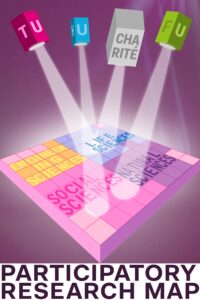
Open Engagement with societal stakeholders is one of the four pillars of the UNESCO Recommendation on Open Science. The Berlin University Alliance Participatory Research Map maps over 90 projects in which researchers collaborate with societal stakeholders. With the Participatory Research Map, we not only want to increase the visibility of participatory research but also explore how different stakeholders and research modes contribute to open science and open knowledge generation.

In this third event in our Magnifying Open Science Event Series, there will also be presentations from two other projects focusing on monitoring societal engagement:

  • Margaret Gold (Center for Science and Technology Studies, Leiden University, the Netherlands) will introduce Project MEECSE: Monitoring the implementation of Enabling Environments for Citizen Science & Societal Engagement practices, and,
  • Dr. Antonella Maiello (Faculty of Governance and Global Affairs, Leiden University, The Netherlands) and Dr. Dan Petrovics (Faculty of Governance and Global Affairs, Leiden University, The Netherlands) will introduce Project EmPowerED: Enabling Positive Energy Districts through citizen-centered socio-technical models for upscaling of the heat transition.

We will discuss the needs, possibilities and challenges of monitoring societal engagement from different angles, and we also like to engage with the audience and discuss how we can collaboratively contribute to magnifying openness in engaging with societal stakeholders.

Explore the Participatory Research Map: https://quest-participatory-research-map.charite.de/

Barcamp Open Science 2025: From Threats to Collective Resilience

Safeguarding research and protecting knowledge infrastructures from political, digital, and structural threats was among the topics of this year’s Barcamp Open Science in Berlin. Other sessions revolved for instance around shadow libraries, the underuse of research data management infrastructure and the question whether projects dealing with data management like EOSC and NFDI have “gentrified” the discourse on Open Science. The participants also performed interesting mind experiments and shared their Open Science success stories.

By Susann Auer, Julien Colomb, Maaike Duine, Lambert Heller, Ilona Lipp, Tilo Mathes, Daniel Nüst, Guido Scherp, Katharina B. Schmitt and Christopher Schwarzkopf

„Barcamp Open Science 2025: From Threats to Collective Resilience“ weiterlesen

Online L(a)unch of the Participatory Research Map

  • When: 2 December 2025, 12:00 a.m. – 1:15 p.m. (online)
  • Register here!

Discover the diversity of participatory research in Berlin!

We warmly invite you to the online launch of the Participatory Research (PR) Map – an interactive tool that showcases projects in which science and society collaborate.

What is the Participatory Research Map?

The PR Map features projects across various formats of participatory research, including Citizen Science, Living Labs, Patient Engagement, Collaborative Action Research, and Transdisciplinary Research. It highlights the networks within the Berlin University Alliance (BUA) and beyond – and helps foster new opportunities for collaboration and knowledge exchange.

The Participatory Research Map aims to:

  • Increase visibility and accessibility of participatory research
  • Strengthen inter- and transdisciplinary collaborations
  • Facilitate knowledge exchange between science and society
  • Inspire new partnerships for future participatory projects

What to expect at the L(a)unch:

In addition to an introduction to the development and functionality of the map, you will gain insights into concrete examples of participatory research projects within the Berlin research area. Together, we would like to discuss how this tool can support research collaboration and networking – all in a relaxed lunchtime atmosphere.

Save the date: Follow the link to register!

We’d love to hear from you! If you have any questions or feedback about the Participatory Research Map or the L(a)unch event, feel free to get in touch at: participatory-research@berlin-university-alliance.de

The Participatory Research Map is the result of cooperation between the BUA project Open Science Magnifiers and the BUA structural project TD-Lab.